Texts to Send When He Stops Replying (And What to Do When the Silence Stretches Too Long)

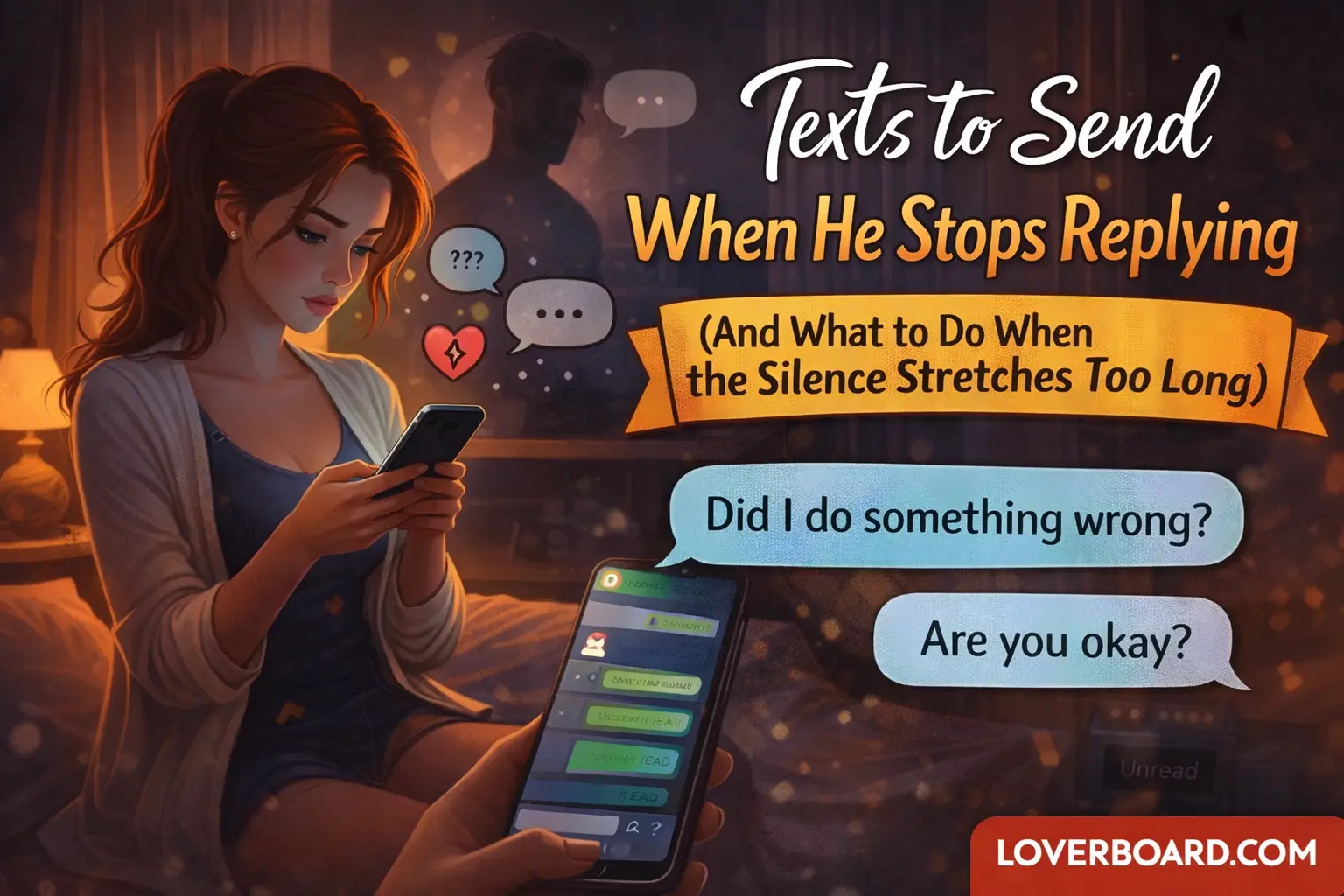
She had fourteen drafts saved in her notes app.
Not fourteen versions of the same message — fourteen completely different texts. Some were casual. Some were funny. One was three sentences long and started with hey, just wanted to check in. Another was just a single line: I guess you’re busy. She’d written them over three days, deleted them, rewritten them, and still hadn’t sent anything.
When she finally came to me, she said: “I don’t even know what to say anymore. I just don’t want to seem desperate. But I also don’t want to pretend I’m not thinking about it.”
That’s the exact tension most women find themselves in when a guy goes quiet. Not the dramatic, obvious silence — the slow kind. The kind where you’re not sure if you’re overreacting or under-reacting. The kind where every text you write sounds either too much or too little.
So let’s talk about what to actually send.
First — Why This Feels So Hard
The reason you’re stuck isn’t because you don’t know how to send a text. You’ve been doing that since you were twelve.
The reason it feels hard is because you’re trying to solve two problems at once: reaching out and protecting yourself at the same time. You want to say something that’s honest without being vulnerable. Something that’s warm without being needy. Something that opens the door without looking like you’ve been standing in front of it, waiting.
That’s not a simple thing to write. And I want to be clear — the fact that you’re thinking about it this carefully doesn’t mean you’re overthinking. It means you actually care how you show up. That matters.
But here’s what I’ve noticed with women who spend days in that drafts folder: the longer the silence sits, the more pressure each potential text starts to carry. One message starts to feel like it has to accomplish everything — re-establish connection, get an answer, protect your dignity, and not reveal how much you’ve been thinking about it.
No text can do all of that. And the ones that try to? They’re usually the ones you regret.
The Texts That Feel Right But Aren’t
Before I share what actually works, I want to talk about the ones that don’t — because most of them will feel tempting. Some of them will feel powerful in the moment. That’s exactly why they’re worth naming.
1. The Casual Meme or Random Link
This one is very common. You find something funny, something he’d normally respond to, and you use it to slip back in without technically re-initiating. It feels low-stakes. It feels light. But underneath it, you and I both know what it is — a test dressed up as a joke. And the thing about tests is that they don’t actually give you clarity. They give you anxiety wearing the costume of information.
Because even if he responds, you don’t know what the response means. Does it mean he’s back? Does it mean he’s just being polite? You’re still in the same place, just with more to analyze.
2. The “Just Checking In” Text Sent More Than Once
The first time is fine. Genuine, even. But I’ve watched many women send a version of this text two or three times, spacing them out, making each one slightly more casual — as if the casualness would eventually stop feeling desperate. It doesn’t. Each follow-up shifts the dynamic a little further. Not because checking in is wrong, but because repeatedly reaching out to someone who isn’t reaching back stops being connection and starts being pursuit.
There’s a difference between staying in touch and chasing. You deserve to know which one you’re doing.
3. The “I Guess You’re Busy” Passive Text
This one is the hardest to talk about because it usually comes from a real place of hurt. It’s the text that’s trying to communicate disappointment while still leaving a door open. It wants him to feel the weight of his silence without you having to say it directly.
But here’s what usually happens: he either doesn’t respond at all, or he responds with something so vague and apologetic that you’re back to square one. It creates a moment of tension without creating any clarity. And clarity — not tension — is what you actually need.
Now. That doesn’t mean you shouldn’t ever express how you feel. It means the timing and framing matter more than most people realize.
The Texts That Actually Work — And When to Send Each One
What I’m going to share with you aren’t scripts designed to manipulate a response. They’re messages written from a grounded place — ones that give him the chance to show up, while making it clear that you’re not disappearing while he figures out whether he wants to.
Text One: The Simple Warm Check-In
This is for early in the silence — a few days, not weeks. When you genuinely don’t know what’s happening and you’re not yet in a place of hurt, just uncertainty.
“Hey — I’ve been thinking about you. Hope everything’s okay on your end.”
That’s it. One text. No follow-up for a while.
What makes this work isn’t that it’s clever. It’s that it’s honest. You are thinking about him. You do hope he’s okay. It leaves space for him to respond naturally without putting pressure on what the response has to mean. And the absence of a question mark at the end matters — you’re not demanding a reply. You’re simply letting him know you’re there.
Send it once. Then let it breathe.
Text Two: The Acknowledging-the-Shift Text
This one is for when the silence has gone on long enough that something clearly shifted — and you know it, and he knows you know it — but nothing’s been said directly.
“I’ve noticed things have been quieter between us. I’m not sure what’s going on, but I wanted to say that I’m open to talking if you want to.”
This text does something important: it names reality without dramatizing it. It doesn’t accuse. It doesn’t plead. It doesn’t pretend. It says, simply, I see what’s happening, and I’m not going to perform like I don’t.
Because that’s the thing about silence — it usually doesn’t exist in a vacuum. Something shifted. And pretending it didn’t isn’t dignity. It’s just a different kind of waiting.
What this text also does is hand him something to respond to. Not a test. Not a trap. An actual opening. If he wants to step through it, he can. And if he doesn’t — that’s information too.
Text Three: The Clarity Text
This one is for when you’ve given enough time and space, and you’ve decided you need an answer — not because you’re desperate, but because you’re done being uncertain.
“I think I deserve to know where we stand. If something’s changed for you, I’d rather know. I’m not going to be upset — I just need honesty more than I need comfortable silence.”
This is the text you send when you’ve made peace with either outcome. When you’re ready to hear yes, something changed just as much as you’re ready to hear I’m sorry, I’ve just been in my head. If you’re not there yet — if part of you is still hoping the right words will fix it — wait. Send this one when you mean it.
Because this text works precisely because it doesn’t need anything from him. It’s not trying to convince him. It’s not performing coolness. It’s just a woman who knows her own value and is asking — directly, kindly — to be treated accordingly.
Text Four: The Closing Text
This is the last one. The one you send not to get a response, but to leave cleanly — with your dignity intact and your own feelings honored.
“I’ve enjoyed the time we spent together. I hope you’re well. But I’m going to stop reaching out — not out of anger, just out of respect for myself.”
I’ve seen women hesitate to send this one because it feels final. It is. That’s what makes it powerful. Not aggressive, not cold — just clear. This text doesn’t leave a door open. And sometimes, closing the door yourself is the most grounded thing you can do.
At first, that might feel like loss. But over time, you’ll recognize it as something else entirely. A kind of self-possession that quietly changes how you carry yourself — not just in this situation, but in the ones that come after.
What His Response — or His Silence — Is Actually Telling You
Here’s what I often ask women once they’ve sent a message and received either something vague or nothing at all: What did you learn?
Not what did you hope. What did you actually learn.
Because the response a man gives when you reach out honestly — especially when it’s calm and without drama — tends to be the truest signal you’ll get. Not perfectly honest, not always complete. But true enough to pay attention to.
A man who’s genuinely interested but genuinely caught up in something real — he responds. Maybe not immediately, but within a day or two, with something that actually acknowledges what you said. He doesn’t leave you hanging with a one-word reply and a promise to talk soon that never happens.
A man who’s pulling back — maybe because he’s decided he doesn’t want what you want, maybe because he’s conflict-avoidant, maybe because he never quite knew what he wanted — that man tends to either disappear or respond with so little that it answers the question anyway.
Both of those are information. One of them just feels better to receive than the other.
Pay attention to the pattern, not the individual message. Not the one warm reply after three days of nothing. The pattern.
One More Thing Before You Send Anything
I want to say this to you directly, because I wish someone had said it to me years ago when I was in a situation very similar to yours.
The text isn’t the thing that matters most.
I know that sounds strange in an article literally about texts. But hear me out. The text matters in the sense that it should be honest and calm and yours. But what matters more is what you decide before you send it.
Have you decided that his response — whatever it is — won’t change your understanding of your own worth? Have you decided that reaching out means you care about the connection, not that you can’t survive without it? Have you decided that if he doesn’t respond the way you hope, you’ll be okay — not perfect, not painless, but okay?
If the answer to those questions is yes, send the text. Any of them. The exact wording matters much less than the place you’re sending it from.
And if the answer is not yet — that’s okay too. Sit with it a little longer. Let yourself get there. Because the most powerful text you can send is one written from a woman who already knows she’ll be fine either way.
That version of you is always worth waiting for.